Transsphincteric Fistula Treatment in Hyderabad
Table of Contents
Transsphincteric Fistula Treatment in Hyderabad
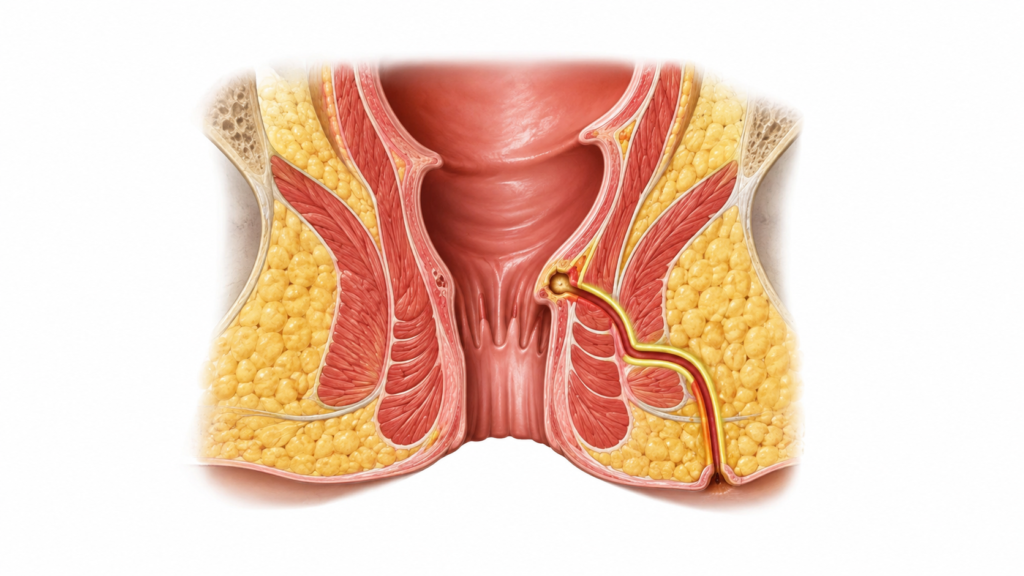
An anal fistula (fistula-in-ano) is an abnormal, infected tunnel connecting a crypt gland inside the anal canal to an external opening on the perianal skin. Among the various types of anorectal fistulas, a Transsphincteric Fistula is one of the most complex. Accounting for roughly 25% of all perianal fistulas, a transsphincteric tract burrows directly through both the internal and external anal sphincter muscles.
Parks Anatomical Classification of Anal Fistulas
- Intersphincteric Fistula (70% — Most Common): Tract remains between the internal and external sphincter muscles. Minimal muscle involvement and low incontinence risk.
- Transsphincteric Fistula (25% — Complex & Muscle-Traversing): Tract burrows directly through both internal and external sphincter muscles. High risk of incontinence if cut; requires sphincter preservation.
- Suprasphincteric Fistula (5%): Tract loops over the puborectalis muscle before exiting the skin. Requires specialized LIFT, VAAFT, or Seton management.
- Extrasphincteric Fistula (1% — Rare): Tract bypasses the anal sphincter complex completely, starting high in the rectum. Usually caused by trauma, pelvic inflammation, or Crohn’s disease.
Because the transsphincteric tract passes through the external anal sphincter muscle—which provides voluntary control over gas and bowel movements—traditional open cutting (fistulotomy) carries a high risk (15% to 35%) of causing irreversible fecal incontinence. Modern proctology in Hyderabad focuses on sphincter-preserving, minimal-access procedures—such as FiLaC (Fistula-Tract Laser Closure), LIFT (Ligation of Intersphincteric Fistula Tract), and VAAFT (Video-Assisted Anal Fistula Treatment).
Leading proctology centers across Hyderabad—including Jubilee Hills, Banjara Hills, HITECH City, Gachibowli, Secunderabad, and Kukatpally—offer specialized sphincter-preserving care. By combining 3D pelvic MRI Fistulography with advanced diode lasers and microsurgical techniques, specialists eliminate infected tracts while keeping muscle function completely intact.
1. Clinical Sub-Types: Low vs. High Transsphincteric Fistulas
Proctologists divide transsphincteric fistulas into two anatomical sub-categories based on the height at which the tract crosses the external anal sphincter muscle:
- Low Transsphincteric Fistula: The tract passes through the lower third of the external sphincter muscle, involving less than 30% of total sphincter muscle mass. Surgical options include FiLaC Laser, LIFT, or partial sphincterotomy with reconstruction.
- High Transsphincteric Fistula: The tract burrows through the upper two-thirds of the external sphincter muscle, involving significant muscle volume near the puborectalis muscle. Surgical options require mandatory sphincter preservation via LIFT, FiLaC, VAAFT, or Seton placement.
Accurately distinguishing between low and high transsphincteric tracts requires pre-operative 3D MRI Fistulography to prevent accidental muscle damage.
2. Advanced Sphincter-Preserving Surgical Techniques in Hyderabad
Colorectal surgeons and proctologists in Hyderabad utilize modern techniques designed to seal or remove the infected tract without cutting sphincter muscles:
A. FiLaC (Fistula-Tract Laser Closure)
FiLaC is a minimally invasive laser procedure performed under short general or spinal anesthesia. The surgeon cleans the fistula tract of infected tissue. A flexible, 360-degree radial diode laser fiber (1470 nm wavelength) is inserted into the tract from the external skin opening. As the fiber is slowly withdrawn, controlled laser energy photothermalizes the internal lining. The tissue walls collapse and seal shut naturally without open cuts or stitches.
B. LIFT (Ligation of Intersphincteric Fistula Tract)
The LIFT procedure is a surgical technique developed specifically for high transsphincteric fistulas. The surgeon makes a small incision in the natural groove between the internal and external sphincter muscles (intersphincteric space). The fistula tract is isolated as it passes between the muscles, tied off (ligated) securely with absorbable sutures near the internal opening, and divided. The infected tissue inside the tract is removed without cutting any sphincter muscle fibers.
C. VAAFT (Video-Assisted Anal Fistula Treatment)
VAAFT utilizes a specialized endoscope (fistuloscope) connected to a video monitor. The surgeon inserts the scope through the external opening, directly visualizing the interior of the fistula tunnel. This allows the surgeon to identify hidden secondary side branches or blind abscess cavities. Electro-cautery destroys the tract lining under direct vision, and the internal opening is closed using mucosal flap sutures or endoscopic clips.
D. Staged Seton Placement
For high transsphincteric fistulas complicated by active acute infection or perianal abscess, a non-absorbable surgical thread (seton) is placed through the tract. The seton remains in place for 4 to 8 weeks to maintain continuous drainage, clear acute inflammation, and firm up the tract walls before definitive LIFT or FiLaC laser closure is performed.
3. Comprehensive Cost Breakdown for Hyderabad
Pricing for transsphincteric fistula treatment in Hyderabad depends on tract height (low vs. high), presence of secondary side branches, chosen procedure (FiLaC laser, LIFT, or VAAFT), hospital room category, and surgeon qualifications.
- Senior Proctologist Consultation: ₹600 – ₹1,200 (Outpatient visit)
- 3D Pelvic MRI Fistulogram: ₹4,500 – ₹8,500 (Outpatient diagnostic mapping)
- FiLaC Laser Closure (Low Transsphincteric): ₹55,000 – ₹75,000 (Daycare stay; discharge in 6 hours)
- FiLaC Laser Closure (High Transsphincteric): ₹75,000 – ₹95,000 (Daycare to 24-hour stay)
- LIFT Procedure (High Transsphincteric): ₹65,000 – ₹95,000 (Daycare to 24-hour stay)
- VAAFT Endoscopic Surgery: ₹80,000 – ₹1,20,000 (24-hour inpatient stay)
- Staged Seton Placement (Phase 1): ₹35,000 – ₹55,000 (Daycare procedure)
4. Method Comparison: Open Surgery vs. Laser FiLaC vs. LIFT
| Clinical Parameter | Traditional Open Fistulotomy | Modern Laser FiLaC Closure | LIFT Procedure |
|---|---|---|---|
| Sphincter Muscle Strategy | Cuts through external sphincter | Preserves 100% of muscle fibers | Preserves 100% of muscle fibers |
| Fecal Incontinence Risk | High Risk (15% to 35%) | Negligible Risk (< 1%) | Negligible Risk (< 1%) |
| Wound Profile | Large open wound requiring daily packing | Stitchless (Tiny needle port) | Small hidden incision in intersphincteric groove |
| Post-Op Pain Level | Severe | Minimal to Mild | Mild |
| Hospital Stay | 2 to 4 Days | Same-Day Discharge (6 hrs) | Daycare to 24 Hours |
| Recovery / Return to Work | 4 to 8 Weeks | 3 to 5 Days | 4 to 7 Days |
| Average Cost Range | ₹35,000 – ₹55,000 | ₹55,000 – ₹95,000 | ₹65,000 – ₹95,000 |
5. What to Expect During Your Surgical Journey
- Specialist OPD Assessment & MRI Scan: Your proctologist conducts a physical evaluation and orders a 3D pelvic MRI Fistulogram to map the exact height of the transsphincteric tract, secondary branches, and internal opening.
- Pre-Operative Preparation: Routine blood panels, coagulation profiles, and ECG are completed. A mild fleet enema is administered on the morning of surgery to prepare the rectum.
- Operative Procedure: Under general or spinal anesthesia, the surgical team executes the planned procedure—whether laser FiLaC ablation, LIFT ligation, or VAAFT—sealing the tract in 30 to 45 minutes without cutting sphincter muscles.
- PACU Recovery & Discharge: After resting in the recovery lounge for 4 to 6 hours, you receive light fluids, walk comfortably, and are discharged home the same evening or the following morning.
- Post-Op Home Care & Follow-Up: You take warm sitz baths 2 to 3 times daily, use stool softeners, maintain local hygiene, and eat a high-fiber diet. Most patients return to light desk work within 3 to 5 days.
6. Post-Operative Care, Sitz Baths, and Preventing Recurrence
- Warm Sitz Bath Protocol: Soak in a tub of warm water for 10 to 15 minutes, 2 to 3 times daily (and immediately after every bowel movement) to relax muscle spasms, cleanse the area, and speed up tissue healing.
- Diet and Stool Softeners: Take prescribed stool softeners (such as liquid paraffin or lactulose) to prevent straining. Eat fiber-rich foods (papaya, oats, cooked vegetables) and drink 3 to 4 liters of water daily.
- Hygiene and Activity: Gently pat the area dry with a soft towel or hair dryer on cool mode after washing. Avoid heavy weightlifting, cycling, or strenuous core exercises for 2 to 3 weeks.

Frequently Asked Questions (15 Clinical FAQs)
1. What is a transsphincteric anal fistula?
A transsphincteric fistula is an abnormal infected tunnel that originates in the anal crypt gland and burrows directly through both the internal and external anal sphincter muscles before exiting on the perianal skin. It accounts for roughly 25% of all perianal fistulas and requires specialized sphincter-preserving surgery to prevent fecal incontinence.
2. What is the best treatment for a transsphincteric fistula in Hyderabad?
Sphincter-preserving procedures—such as FiLaC (Fistula-Tract Laser Closure), LIFT (Ligation of Intersphincteric Fistula Tract), and VAAFT (Video-Assisted Anal Fistula Treatment)—are considered the gold standard. They close or obliterate the fistula tunnel without cutting the external sphincter muscle, protecting bowel control.
3. How much does transsphincteric fistula treatment cost in Hyderabad?
The cost of treating a transsphincteric fistula in Hyderabad ranges from ₹55,000 to ₹1,30,000, depending on tract height (low vs. high transsphincteric), presence of secondary side branches, chosen technology (FiLaC laser, LIFT, or VAAFT), hospital tier, and pre-op 3D MRI Fistulogram imaging.
4. Why is traditional open fistulotomy unsafe for a transsphincteric fistula?
In a transsphincteric fistula, the tract passes through major portions of the external anal sphincter muscle. Performing a conventional open fistulotomy involves cutting through these muscle fibers, carrying a high risk (15% to 35%) of irreversible gas or stool incontinence.
5. How does FiLaC (Fistula-Tract Laser Closure) work for transsphincteric fistulas?
A flexible 360-degree radial diode laser fiber is introduced into the fistula tract from the external opening. Controlled laser energy photothermalizes the internal lining of the tunnel as the fiber is withdrawn, sealing the tract shut from within while keeping sphincter muscles completely intact.
6. What is the LIFT procedure, and when is it recommended?
LIFT (Ligation of Intersphincteric Fistula Tract) is a surgical technique where a small incision is made in the intersphincteric groove to isolate the fistula tract between the sphincter muscles. The surgeon ties off (ligates) and divides the tract near the internal opening without cutting any sphincter muscle fibers.
7. Is an MRI Fistulogram mandatory before transsphincteric fistula surgery?
Yes. A 3D pelvic MRI Fistulogram is critical prior to surgery. It provides detailed anatomical mapping of the exact percentage of sphincter muscle traversed, secondary horseshoe extensions, supralevator branching, and the precise location of the internal opening.
8. How long is the hospital stay for laser or LIFT transsphincteric fistula surgery?
Most sphincter-preserving procedures (FiLaC laser or LIFT) are performed as daycare or 24-hour stay admissions. Patients are routinely discharged either the same evening or the following morning.
9. How soon can I return to work after transsphincteric fistula treatment?
Patients undergoing laser FiLaC or LIFT procedures typically resume light desk work within 3 to 5 days, compared to 4 to 8 weeks required for open fistulotomy wounds.
10. Is transsphincteric fistula surgery covered under health insurance in India?
Yes. Medically necessary sphincter-preserving fistula surgeries (FiLaC, LIFT, VAAFT, or seton placement) are standard covered benefits under private health insurance policies, corporate group coverage, and TPA desks across empaneled hospitals.
11. What is a cutting seton, and when is it used for transsphincteric fistulas?
A cutting seton is a surgical thread placed through the fistula tract and tied under moderate tension. Over several weeks, it slowly cuts through the encompassed sphincter muscle while fibrosis forms behind it, preserving continence while opening the tract.
12. What is the difference between low transsphincteric and high transsphincteric fistulas?
A low transsphincteric fistula passes through the lower third of the external sphincter muscle, involving minimal muscle mass. A high transsphincteric fistula burrows through the upper two-thirds of the external sphincter, involving significant muscle volume and requiring advanced preservation techniques like LIFT or FiLaC.
13. What post-operative care is required after transsphincteric fistula surgery?
Post-op care includes taking warm sitz baths 2 to 3 times daily, using oral stool softeners to prevent straining, maintaining dry local hygiene, eating a high-fiber diet, drinking 3 liters of water daily, and completing prescribed antibiotics.
14. Can a transsphincteric fistula reoccur after laser or LIFT treatment?
While sphincter-preserving techniques carry high success rates (80% to 92%), recurrence can occur in 8% to 15% of cases if secondary side branches remain unsealed or if underlying inflammatory bowel disease (Crohn’s) is present. Pre-operative MRI mapping minimizes recurrence.
15. How do I choose the best hospital for transsphincteric fistula treatment in Hyderabad?
Select NABH-accredited facilities featuring dedicated laser proctology suites, experienced colorectal surgeons or proctologists (MS/DNB with laser/LIFT fellowships), access to 3D pelvic MRI Fistulography, and transparent package pricing.