
EV Charger Installation for Corporate Offices: Enterprise Guide (2026)
Table of Contents
EV Charger Installation for Corporate Offices: Enterprise Guide (2026)
As global organizations intensify their commitment to Net-Zero targets, Business Responsibility and Sustainability Reporting (BRSR), and Environmental, Social, and Governance (ESG) frameworks, workplace infrastructure is evolving rapidly. Among facility enhancements, EV charger installation for corporate offices has shifted from a novel perk to an essential enterprise requirement.
Offering workplace EV charging provides a powerful employee value proposition, attracting high-performing talent while accelerating the transition away from fossil fuel transport. Furthermore, electrification directly addresses corporate Scope 3 emissions—which encompass employee commuting habits—and helps secure valuable points toward LEED, WELL, and IGBC green building certifications.
However, deploying charging infrastructure across corporate IT parks, tech hubs, and multi-tenant commercial towers involves navigating complex electrical load balancing, access control mechanisms, commercial lease agreements, and corporate billing integrations.
This comprehensive guide delivers a step-by-step framework for Chief Sustainability Officers (CSOs), Facility Directors, HR Executives, and Corporate Real Estate Managers evaluating, deploying, and managing workplace EV charging infrastructure.
Strategic Value Proposition: Why Enterprises Are Electrifying Workplaces
Integrating electric vehicle charging infrastructure into enterprise parking facilities yields measurable benefits across human resources, facility operations, and corporate sustainability reporting.
                    CORPORATE EV INFRASTRUCTURE VALUE TRIPLE-BOTTOM-LINE

         +--------------------+     +--------------------+     +--------------------+
         |    TALENT & HR     |     |    SUSTAINABILITY  |     | REAL ESTATE VALUE  |
         |  • Employee Perk   |     |  • Scope 3 Offsets |     |  • IGBC / LEED Pts |
         |  • EV Driver Retention|  |  • BRSR Compliance |     |  • Higher Asset Value|
         +--------------------+     +--------------------+     +--------------------+
Key Drivers for Corporate Adoption
- Addressing the “Workplace Dwell Time” Advantage: Employees park their vehicles at office facilities for 8 to 10 hours daily. This long dwell time eliminates the need for expensive high-output DC fast chargers, making lower-cost AC Level 2 wallbox chargers (7.4 kW to 22 kW) ideal for complete daily battery replenishment.
- Accelerating Corporate Fleet Electrification: Companies transitioning corporate shuttle fleets, executive sedans, or sales representative vehicles to electric models require reliable on-site charging during business hours and overnight parking.
- Enhancing Brand & ESG Credentials: Visible charging stations in corporate parking structures serve as a physical demonstration of environmental stewardship to visiting clients, investors, and regulatory auditors.
Architectural Models: Dedicated vs. Multi-Tenant Office Buildings
The engineering approach for EV charger installation for corporate offices varies significantly based on property ownership models.
                           OFFICE INFRASTRUCTURE MODELS

  ┌──────────────────────────────────────────┬──────────────────────────────────────────┐
  │ Single-Tenant Corporate Campus           │ Multi-Tenant IT Park / Commercial Tower  │
  ├──────────────────────────────────────────┼──────────────────────────────────────────┤
  │ • Fully owned/leased main switchboard    │ • Shared electrical meter bank            │
  │ • Unlimited control over cabling routes  │ • Requires Landlord / Facility NOC       │
  │ • Integrated with corporate SSO / Badge  │ • Requires sub-metering & CAM billing    │
  │ • Direct tie-in to rooftop Solar PV      │ • Dynamic power allocation per tenant    │
  └──────────────────────────────────────────┴──────────────────────────────────────────┘
1. Single-Tenant Corporate Campuses
Enterprises occupying independent facilities or campus grounds enjoy total autonomy over electrical sub-stations, parking layouts, and access rules. Installations can draw power directly from the main campus low-voltage distribution board (LVDB) or connect to campus solar microgrids.
2. Multi-Tenant Commercial Parks
Enterprises leasing floor space in multi-tenant office towers must coordinate closely with the master facility developer or Property Management Company (PMC).
- Sub-Metering Requirement: A dedicated check-meter must be installed to monitor energy consumption separately from general common area maintenance (CAM) power usage.
- No Objection Certificate (NOC): Facility managers require detailed engineering drawings ensuring cable trays, floor core-drilling, and circuit breakers comply with overall tower electrical safety plans.
Technical Feasibility & Electrical Load Auditing
Before procuring charging hardware, facility teams must conduct a thorough electrical capacity assessment to determine the site’s maximum power capacity.
                  TYPICAL WORKPLACE POWER DISTRIBUTION ARCHITECTURE

  +-----------------------+     +-----------------------+     +-----------------------+
  | HT Utility Sub-Station| --> | Main LV Panel /       | --> | EV Sub-Distribution   |
  | (11kV Step-down)      |     | Switchgear Panel      |     | Panel (Dedicated)     |
  +-----------------------+     +-----------------------+     +-----------------------+
                                                                          │
                                            ┌─────────────────────────────┴─────────────────────────────┐
                                            ▼                                                           ▼
                                +-----------------------+                                   +-----------------------+
                                | Smart AC Chargers     |                                   | Smart DC Fast Charger |
                                | (7.4 kW - 22 kW)      |                                   | (30 kW - 60 kW)       |
                                +-----------------------+                                   +-----------------------+
Sizing the Corporate Power Envelope
Consider a corporate headquarters parking garage deploying 30 AC Level 2 Wallbox Chargers (7.4 kW) for employee vehicles and 2 Dual-Gun DC Chargers (60 kW) for executive cars and employee shuttles.
                        CORPORATE WORKPLACE LOAD AUDIT TABLE

  ┌────────────────────────┬───────────┬──────────────────┬──────────────────┐
  │ Load Category          │ Quantity  │ Output per Unit  │ Total Peak Load  │
  ├────────────────────────┼───────────┼──────────────────┼──────────────────┤
  │ Employee AC Wallboxes  │ 30 Units  │ 7.4 kW AC        │ 222 kW           │
  │ Fleet DC Fast Chargers │ 2 Units   │ 60 kW DC         │ 120 kW           │
  │ Auxiliary & Lighting   │ --        │ Base System Load │ 18 kW            │
  ├────────────────────────┼───────────┼──────────────────┼──────────────────┤
  │ Raw Connected Load     │           │                  │ 360 kW           │
  │ Diversity Factor (0.7) │           │                  │ 252 kW           │
  │ Required Transformer   │           │                  │ 315 kVA to 400 kVA│
  └────────────────────────┴───────────┴──────────────────┴──────────────────┘
Engineering Tip: Applying Dynamic Load Management (DLM) software balances charging loads dynamically. If office air conditioning (HVAC) spikes during hot summer afternoons, the DLM controller temporarily scales back charger output, keeping overall building power usage within contracted limits and avoiding heavy DISCOM demand penalties.
Step-by-Step Corporate Deployment Roadmap
A structured engineering and project execution methodology ensures smooth deployment with zero interruption to daily business operations.
                  CORPORATE EV DEPLOYMENT WORKFLOW

  Phase 1: Demand Assessment & Employee Survey
     │
  Phase 2: Electrical Audit & Load Sanction Assessment
     │
  Phase 3: Landlord Clearance (NOC) & Civil Design
     │
  Phase 4: Hardware Procurement & CMS Software Selection
     │
  Phase 5: Electrical Piping, Cabling & Safety Installation
     │
  Phase 6: Testing, SSO Integration, Commissioning & Rollout
Phase 1: Employee EV Adoption Survey
Distribute an internal survey to evaluate current EV ownership, planned EV purchases over the next 12–24 months, average commute distances, and interest in workplace charging. This data establishes accurate baseline capacity requirements.
Phase 2: Civil Engineering & Parking Allocation
Select easily accessible parking bays, ideally located on upper basement levels or near main building entry points to minimize long cable runs from electrical rooms. Ensure parking stalls feature clear green floor painting, EV signage, and protective steel bollards.
Phase 3: Hardware Procurement & Cable Routing
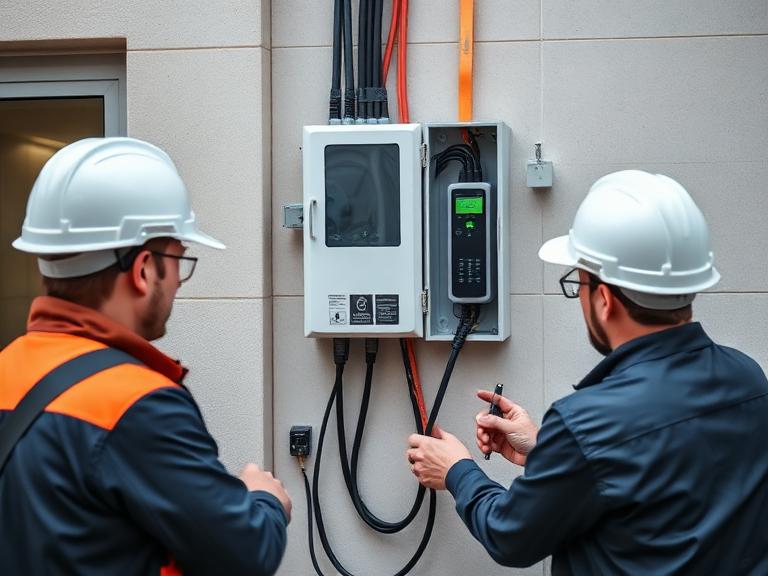
Lay heavy-duty, Flame-Retardant Low-Smoke (FRLS) armored cabling over galvanized cable trays. Install dedicated earth pits to keep ground resistance below 1.0 Ohm.
Phase 4: Network & Software Integration
Connect all smart chargers to the central corporate network via Ethernet, Wi-Fi, or industrial 4G SIM cards, ensuring seamless integration with the Charger Management System (CMS).
Software Management: Access Control, Billing & Corporate SSO
Managing corporate workplace charging stations requires robust backend software to regulate access, prevent misuse, enforce fair usage policies, and handle billing smoothly.
                     CORPORATE SOFTWARE ECOSYSTEM

  +-----------------------+     +-----------------------+     +-----------------------+
  | Corporate Badge / RFID| --> | Cloud-based CMS       | <-- | HR Admin Portal       |
  | or Mobile App (SSO)   |     | Engine (OCPP 1.6J)    |     | (Access Privileges)   |
  +-----------------------+     +-----------------------+     +-----------------------+
                                            │
                                            ▼
                           +---------------------------------+
                           | Automated Payroll Deduction     |
                           | & Carbon Offset Audit Dashboards|
                           +---------------------------------+
Access Control Options for Corporate Campuses
- RFID Employee ID Badges: Employees simply tap their existing company access card against the charger to authenticate and start charging.
- Corporate Single Sign-On (SSO): Integration with Microsoft Entra ID (Azure AD), Okta, or Google Workspace lets employees log into the EV mobile app using their standard corporate credentials.
- Domain Whitelisting: Restricts charging access exclusively to users registered with verified company email addresses (
@company.com).
Popular Workplace Commercial Billing Models
- Fully Subsidized (100% Free as an Employee Perk): The company absorbs all electricity costs as a tax-deductible employee welfare benefit.
- At-Cost Billing: Employees pay the exact utility tariff per kWh consumed via automated app wallets or monthly payroll deductions, ensuring cost neutrality for the enterprise.
- Tiered / Time-Based Fair Access Pricing:
- Hours 0 to 3: Free charging (sufficient to cover standard daily commutes).
- Hours 4+: High hourly idle fees applied. This incentivizes employees to move their fully charged vehicles, freeing up bays for colleagues.
Comparative Hardware Matrix for Corporate Settings
Choosing the correct hardware mix ensures efficiency and long-term utility across different parking zones within a corporate complex.
                        WORKPLACE HARDWARE COMPARISON MATRIX

  ┌───────────────────────────┬───────────────────────────┬───────────────────────────┐
  │ Feature / Specification   │ AC Level 2 Wallbox        │ Dual-Gun DC Fast Charger  │
  ├───────────────────────────┼───────────────────────────┼───────────────────────────┤
  │ Power Output              │ 7.4 kW to 22 kW           │ 30 kW to 60 kW            │
  │ Ideal Placement           │ Employee Basement Parking │ Visitor / Executive Bays  │
  │ Target Vehicle Type       │ Personal Employee Cars    │ Corporate Cabs & C-Suite  │
  │ Dwell Time                │ 4 to 8 Hours              │ 45 to 90 Minutes          │
  │ Relative Equipment Cost   │ Low (1x)                  │ High (6x to 10x)          │
  │ Grid Capacity Impact      │ Modest (Scalable via DLM) │ High (Requires Peak Load) │
  └───────────────────────────┴───────────────────────────┴───────────────────────────┘
ESG, BRSR & Carbon Footprint Audit Metrics
Workplace EV charging directly advances corporate sustainability reporting by converting high-emission internal combustion engine (ICE) employee commutes into clean, electric-powered trips.
                    ESG CARBON ACCOUNTING FLOW

  [ EV Charger Output (kWh) ] ──► [ CMS Sustainability Engine ] ──► [ Metric Tons CO2 Prevented ]
                                                                             │
                                                                             ▼
                                                                [ Annual ESG / BRSR Filing ]
Generating Verifiable Sustainability Data
Enterprise-grade CMS platforms provide automated reporting dashboards that calculate:
- Total Clean Energy Delivered: Measures cumulative kilowatt-hours (kWh) supplied across corporate charging points.
- Avoided Scope 3 Tailpipe Emissions: Calculates net CO2 metric tons saved by substituting petrol/diesel mileage with grid electricity.
- Solar Offset Percentage: Tracks the proportion of EV charging power drawn directly from on-site rooftop solar panels versus grid power.
Safety Standards, Compliance & Fire Risk Management
High-density parking garages equipped with multiple high-power chargers require strict safety engineering to protect human life and real estate assets.
Workplace Safety Engineering Essentials
- Residual Current Protection (RCD): Every workplace charger must feature dedicated Type-B RCCBs capable of detecting minute AC and DC leakage currents to prevent electrical shock.
- Emergency Power Off (EPO) Buttons: Install highly visible, red wall-mounted EPO switches at garage exits and near main distribution panels to completely isolate charger power during emergencies.
- Thermal Imaging Surveillance: Installing infrared thermal cameras above charging bays monitors battery pack temperatures in real time, alerting security teams at the first sign of overheating.
- Fire Department Compliance & Equipment: Facilities must feature active overhead sprinkler heads, smoke extractors, and accessible Class-D/CO2 fire extinguishers specifically rated for electrical systems.
15 Frequently Asked Questions (FAQs)
Q1: Why should companies invest in EV charger installation for corporate offices?
Answer: Deploying workplace EV charging acts as a highly valued employee benefit, helps recruit and retain top talent, directly lowers corporate Scope 3 commuting emissions, demonstrates environmental leadership, and earns valuable points toward LEED, WELL, and IGBC green building certifications.
Q2: What type of EV chargers are best suited for corporate office parking lots?
Answer: AC Level 2 Wallbox chargers (7.4 kW to 22 kW) are optimal for general employee parking because vehicles remain parked for 8 to 9 hours daily. Higher-output 30 kW to 60 kW DC fast chargers are best reserved for executive parking bays, visiting clients, or high-utilization corporate cab fleets requiring quick top-ups.
Q3: How do corporate offices handle electricity billing for employee EV charging?
Answer: Companies typically choose one of three models: offering 100% free charging as an employee perk; setting up at-cost per-kWh billing via a smart mobile app wallet; or implementing tiered time-based rates (e.g., free charging for the first 3 hours, followed by hourly fees to encourage bay rotation).
Q4: How does an office manage limited electrical load capacity when adding EV chargers?
Answer: Facilities deploy Dynamic Load Management (DLM) technology. Smart DLM software monitors building energy draw in real time and automatically adjusts power delivered to EV chargers based on HVAC and lighting demand. This prevents circuit overloads and avoids costly maximum demand penalties from power utilities.
Q5: How can corporate office parking ensure chargers are shared fairly among employees?
Answer: Enterprise Charger Management Systems (CMS) enforce fair-use rules. The software sends push notifications when charging completes, limits maximum session durations, and applies automatic “idle penalty fees” if a fully charged vehicle remains parked in a charging bay past a grace period.
Q6: What is the average cost to deploy EV chargers in a corporate campus?
Answer: Installing a 10-bay smart AC Level 2 workplace charging setup typically costs between ₹6 Lakhs and ₹14 Lakhs, covering smart wallboxes, sub-panels, armored cabling, protection gear, and software setup. Adding a 60 kW dual-gun DC fast charger increases project costs by ₹12 Lakhs to ₹18 Lakhs.
Q7: Do workplace EV chargers contribute to ESG and Sustainability reporting?
Answer: Yes. Enterprise CMS platforms track clean energy delivery and generate audited reports detailing avoided carbon emissions. This verifiable data applies directly to corporate Scope 3 reduction goals and annual ESG, BRSR, and sustainability filings.
Q8: Can corporate EV chargers be restricted exclusively to staff members?
Answer: Yes. Hardware access can be secured using employee RFID access cards, corporate Single Sign-On (SSO) integration (e.g., Microsoft Entra ID or Okta), or domain whitelisting within the management app to ensure only authorized personnel use the system.
Q9: What commercial electricity tariff applies to workplace EV charging stations?
Answer: State electricity regulatory commissions offer dedicated commercial EV charging tariffs. Alternatively, energy consumption is metered through the building’s existing High Tension (HT) commercial service connection and managed under standard commercial power agreements.
Q10: Is building owner / facility developer approval required in leased office spaces?
Answer: Yes. Corporate tenants leasing space in commercial parks or office towers must secure a formal No Objection Certificate (NOC) from the park developer or property management company before installing conduits, core-drilling floors, or connecting to main panel banks.
Q11: How long does a workplace EV charger installation project take to complete?
Answer: Deploying a standard 10-to-20 bay AC workplace setup in an existing parking facility takes 2 to 4 weeks. Complex projects requiring new High Tension (HT) transformers or major grid load extensions may take 2 to 3 months.
Q12: What safety equipment is mandatory for basement corporate EV charging bays?
Answer: Key safety equipment includes dedicated chemical earthing, Type-B RCD circuit protection, emergency power cutoff switches, smoke detectors, thermal imaging cameras, overhead sprinkler coverage, and nearby Class-D/CO2 fire extinguishers.
Q13: Can visitors or non-employees use corporate EV chargers during off-hours?
Answer: Yes. Facility teams can configure OCPP-compliant CMS platforms to make campus chargers publicly accessible on weekends or evenings at commercial rates, turning idle workplace infrastructure into an extra revenue stream.
Q14: What maintenance is required for corporate office EV charging stations?
Answer: Routine preventative maintenance should be conducted quarterly. Key steps include inspecting charging cables and connectors, testing residual current safety switches (RCDs), verifying ground resistance values (< 1.0 Ohm), checking distribution panels, and applying over-the-air firmware updates.
Q15: Can solar panels installed on corporate rooftops power the office EV chargers?
Answer: Yes. Integrating workplace chargers with rooftop solar PV arrays or solar carports allows corporate campuses to charge employee vehicles directly with clean solar energy. This maximizes green building incentives and lowers overall operational energy costs.
Strategic Takeaways for Enterprise Leadership
Investing in EV charger installation for corporate offices bridges corporate sustainability policy with practical workplace benefits. By auditing site electrical capacity, selecting OCPP-compliant smart hardware, deploying scalable CMS platforms with corporate SSO integration, and enforcing clear employee charging policies, enterprise leaders can build a modern, future-proof workplace charging infrastructure that drives corporate decarbonization.