Bathroom Plumbing Replacement Hyderabad | Top-Rated Plumbers & Full Pipeline Upgrades
Table of Contents
Bathroom Plumbing Replacement Hyderabad | Top-Rated Plumbers & Full Pipeline Upgrades
Bathroom plumbing serves as the core infrastructure of any modern residential or commercial property. In a rapidly expanding urban metro like Hyderabad—where architectural styles range from classic independent bungalows in Secunderabad and Begumpet to luxury high-rise apartments in Gachibowli, Hitech City, and Kondapur—plumbing systems face distinct environmental and structural demands.
Over time, aging pipe networks succumb to ground movements, mineral scaling, internal corrosion, joint degradation, and persistent leakage. Undertaking a complete Bathroom Plumbing Replacement in Hyderabad is an essential infrastructure upgrade that protects property structure, enhances daily hygiene, eliminates hidden seepage, and increases real estate value.
This comprehensive guide details everything required for a successful bathroom plumbing overhaul in Hyderabad: identifying failure points, selecting anti-corrosive materials, understanding step-by-step installation methodologies, estimating cost breakdowns, and implementing protective measures against regional hard water challenges.
1. Why Hyderabad Homes Require Timely Bathroom Plumbing Replacement
Plumbing systems in Greater Hyderabad Municipal Corporation (GHMC) regions operate under challenging municipal and environmental conditions. Understanding why pipeline replacement becomes mandatory helps homeowners prevent catastrophic structural water damage.
+-------------------------------------------------------------------------------+
|                        PRIMARY DRIVERS FOR REPLACEMENT                        |
+-----------------------------------+-------------------------------------------+
| Challenge Factor                  | Structural Impact                         |
+-----------------------------------+-------------------------------------------+
| High TDS Groundwater / Borewell   | Mineral scaling, pipe blockage, valve lock |
| Legacy GI & Cast Iron Piping      | Internal rust, brown water, wall dampness |
| High Water Pressure Cycles        | Joint pops, hairline cracks in concealed lines|
| Defective Underground/Sub-Slab PVC| Slab seepage, ceiling leaks in flat below |
+-----------------------------------+-------------------------------------------+
A. High TDS & Hard Water Scaling
Hyderabad’s water supply relies heavily on deep borewells alongside municipal river water feeds (Manjeera, Krishna, Godavari). Groundwater across areas like Kukatpally, Manikonda, Miyapur, and Chandanagar carries exceptionally high levels of dissolved calcium and magnesium (TDS often exceeding 600–1200 PPM).
- Over 8 to 15 years, these minerals form thick calcified scale inside supply lines.
- Internal pipe diameters shrink dramatically, choking water velocity to showers and faucets.
- Mineral crusting locks concealed diverters, gate valves, and flush valve internal mechanisms.
B. Degradation of Legacy Galvanized Iron (GI) Pipes
Houses built in Hyderabad prior to the mid-2000s predominantly featured Galvanized Iron (GI) pipe networks.
- Zinc coatings inside GI pipes corrode, exposing raw iron to standing water.
- Corroded GI lines release rust flakes, causing orange-tinted tap water, pinhole leaks inside plastered walls, and structural weakening of masonry bonds.
C. Slab Seepage & Downward Ceiling Leakage
In multi-story apartments and duplex villas across Banjara Hills, Jubilee Hills, and Gachibowli, bathroom floor slabs house waste collection networks. Damaged, un-vented, or poorly glued PVC drain joints leak sewage water into the concrete floor slab. This results in damp patches, saltpeter efflorescence, paint flaking, and mold growth on the ceilings of the lower floor apartment.
2. Key Components Involved in a Complete Bathroom Plumbing Replacement
A full bathroom plumbing overhaul replaces every water supply, waste drainage, and sanitary fixture connection rather than applying temporary surface patches.
A. Freshwater Supply Lines (Inlet Plumbing)
This system routes hot and cold water from the overhead tank, central pressure booster, or geyser to individual outlets:
- Shower diverter units (single lever / thermostatic)
- Washbasin faucets and hot-cold pillar cocks
- Health faucets and hand sprayers
- Western Water Closet (WWC) flush tanks or concealed valves
- Water heater (geyser) inlet and outlet loops
B. Sanitary & Soil Waste Drainage (Outlet Plumbing)
Waste lines convey blackwater (sewage) and greywater (wash water) out of the building safely:
- Soil Pipe Line (110mm / 4 inch): Connects wall-hung or floor-mounted EWCs directly to the vertical soil stack.
- Waste Water Line (75mm / 3 inch): Carries greywater from washbasins, shower areas, and floor traps.
- Multi-Trap / Floor Traps: Sealed water traps preventing sewer gases from escaping into the bathroom living space.
C. Concealed Cistern & Wall-Hung Frame Assemblies
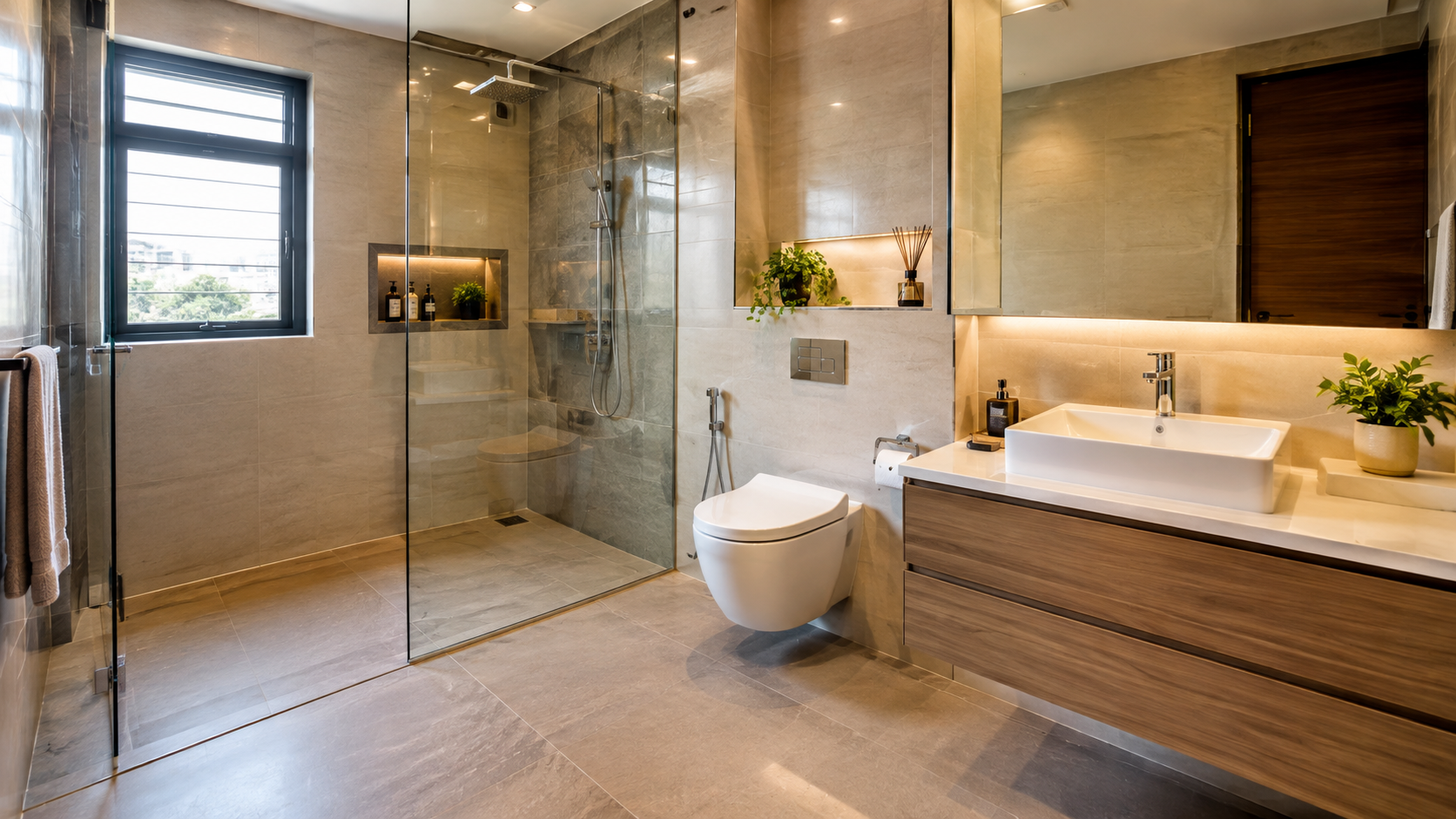
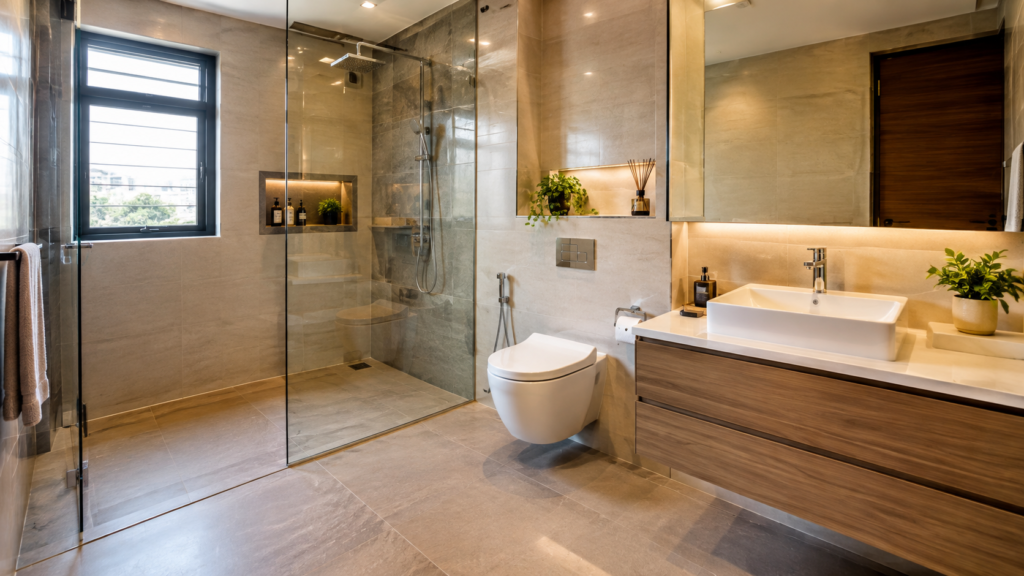
Modern bathroom designs replace bulky floor-mounted commodes with sleek wall-hung closets. This step involves anchoring heavy-duty powder-coated steel frames inside wall chases, routing 110mm soil lines horizontally, and installing concealed push-button flush cisterns.
3. Selecting the Right Plumbing Pipe Materials for Hyderabad Conditions
Selecting high-grade materials guarantees that your replacement plumbing lasts 30 to 50 years without structural degradation.
+-------------------------------------------------------------------------------------------------+
|                                 MATERIAL COMPARISON MATRIX                                      |
+---------------+---------------------+-------------------+---------------------+-----------------+
| Pipe Type     | Primary Usage       | Temperature Limit | Hard Water Resistance| Service Life   |
+---------------+---------------------+-------------------+---------------------+-----------------+
| CPVC          | Hot & Cold Water    | Up to 93°C        | Excellent           | 50+ Years       |
| PPR (Poly)    | Premium Hot/Cold    | Up to 95°C        | Outstanding         | 50+ Years       |
| UPVC          | Cold Water Outlines | Ambient (Cold)    | Good                | 30–40 Years     |
| SWR PVC       | Soil & Waste Drain  | Ambient           | Excellent           | 50+ Years       |
| GI (Legacy)   | Outdated Fresh Line | Up to 60°C        | Very Poor (Rusts)   | 10–15 Years     |
+---------------+---------------------+-------------------+---------------------+-----------------+
1. CPVC (Chlorinated Polyvinyl Chloride) Pipes
CPVC is the default standard for internal concealed water lines across India.
- Benefits: Handles both icy water and boiling water (up to 93°C) without expansion or softening; immune to electrochemical corrosion; smooth inner walls prevent scale deposition.
- Recommended Class: SDR 11 (Class 1) for main pressure drops and SDR 13.5 (Class 2) for standard indoor branches.
2. PPR (Polypropylene Random Copolymer) Pipes
PPR pipes utilize thermal heat fusion welding instead of chemical solvent cement, fusing pipe and fitting into a single continuous piece.
- Benefits: Zero joint failure points; highly resistant to extreme hard water scaling and mechanical impact. Popular in high-end villas and luxury apartments in Jubilee Hills and financial district developments.
3. SWR (Soil, Waste, and Rainwater) PVC Pipes
SWR pipes manage non-pressurized drainage loops.
- Type A: Designed for ventilation and rainwater discharge.
- Type B: Heavy-walled pipes specifically engineered for soil and greywater discharge. Rubber ring-fit (elastomeric seal) or solvent-welded joints ensure leak-free performance under sub-slab settling.
4. Step-by-Step Stepwise Execution Process for Plumbing Replacement
Replacing concealed bathroom plumbing requires coordinated masonry, plumbing, waterproofing, and tile-fitting operations.
1.1. Site Inspection & Hydraulic Layout Drafting:Prerequisite assessment phase.
The master plumber conducts a site audit to map incoming pressure lines, geyser locations, drainage drops, and structural beam boundaries. A 3D or 2D routing diagram is prepared to minimize pipeline cross-overs and reduce unnecessary 90-degree bend fittings that reduce water pressure.
2.2. Demolition, Tile Chipping & Wall Chasing:Precision masonry work.
Existing sanitaryware, faucets, and wall fixtures are carefully dismantled. Wall chasers fitted with diamond blades cut neat channels (grooves) into brickwork or concrete blocks. Tile chipping is limited strictly to pipeline channels to preserve wall stability.
3.3. Removal of Old Piping & Debris Disposal:Site clearing.
Rusted GI lines, choked PVC lines, and degraded clay traps are removed. Debris is cleared from floor drops and chases to ensure clean masonry surfaces for new pipe mounting.
4.4. CPVC Water Supply Installation & Wall Mounting:Pressure line fitting.
New CPVC pipes are cut, deburred, and joined using heavy-duty chemical solvent cement. Pipe lines are aligned horizontally and vertically using spirit levels and anchored firmly inside wall channels with heavy-duty metal pipe clamps spaced every 1 meter.
5.5. Drainage Line Layout & Trap Fitting:Waste line setup.
New SWR PVC Type B lines are installed along floor drops with a mandatory slope (minimum 1:40 gradient toward main vertical stacks). Anti-foul floor traps (P-traps) with deep water seals are embedded in floor pockets to block sewer gas backflow.
6.6. Hydrostatic Pressure Testing (Crucial Quality Gate):Safety verification before plastering.
Before closing wall grooves, the entire CPVC assembly is sealed with end caps, filled with water, and pressurized using a manual hydraulic test pump to 10–12 bar (150+ PSI) for 24 hours. Pressure gauges are monitored for drops to confirm leak-free joints.
7.7. Masonry Backfilling & Chemical Waterproofing:Sub-slab protection.
Wall chases are backfilled with fiber-reinforced polymer mortar. The bare concrete floor slab and wall dados (up to 6 feet in shower zones) are treated with two coats of elastomeric polymer-modified cementitious waterproofing slurry, reinforced with fiber mesh along corners.
8.8. Tiling, Sanitaryware Fitting & Final Commissioning:Final finish phase.
After tile laying and grouting are complete, new sanitaryware (wall-hung commode, vanity basin, shower panel, diverter trims, geyser connections) is mounted, silicone-sealed, and operational flow tested.
5. Cost Breakdown for Bathroom Plumbing Replacement in Hyderabad (2026 Price Benchmarks)
Plumbing replacement expenses in Hyderabad depend on bathroom size, piping material grade, layout complexity, and choice of sanitaryware fixtures.
A. Cost Summary Matrix
| Service Component | Standard Range (per bathroom) | Premium Range (per bathroom) | Key Factors Included |
| Plumbing Labor Charges | ₹7,000 – ₹12,000 | ₹14,000 – ₹22,000 | Wall chasing, pipe fitting, trap setting, sanitaryware installation. |
| Piping & Fitting Raw Materials | ₹8,000 – ₹18,000 | ₹20,000 – ₹38,000 | CPVC SDR-11 pipes, brass elbows, SWR drains, solvent chemicals. |
| Waterproofing Treatment | ₹6,000 – ₹12,000 | ₹14,000 – ₹22,000 | 2-coat elastomeric coating + mesh along joints & corners. |
| Civil Masonry & Demolition | ₹4,000 – ₹8,000 | ₹10,000 – ₹18,000 | Tile breaking, channel cutting, cement backfilling, floor screed. |
| Sanitaryware & Fixture Costs | ₹15,000 – ₹35,000 | ₹45,000 – ₹1,50,000+ | Wall-hung closet, basin, shower diverter, taps, health faucets. |
| Estimated Total Project Cost | ₹40,000 – ₹85,000 | ₹1,03,000 – ₹2,50,000+ | Full end-to-end turnkey bathroom plumbing overhaul. |
B. Material Cost Benchmarks in Hyderabad
+-------------------------------------------------------------------------------+
|                      MATERIAL COST BREAKDOWN (HYDERABAD)                      |
+-----------------------------------+-------------------------------------------+
| Material / Item                   | Approx. Retail Market Rate                |
+-----------------------------------+-------------------------------------------+
| CPVC Pipe (3/4" SDR 11)           | ₹120 – ₹220 per 10-ft length             |
| CPVC Pipe (1" SDR 11)             | ₹180 – ₹320 per 10-ft length             |
| SWR Drain Pipe (110mm / 4 inch)   | ₹350 – ₹650 per 10-ft length             |
| Concealed Single Lever Diverter   | ₹3,200 – ₹9,500 per unit (Jaquar/Hindware)|
| Wall-hung EWC with Concealed Tank | ₹9,000 – ₹28,000 per set                  |
| Multi-Floor Trap with Stainless Grid| ₹450 – ₹1,200 per piece                 |
+-----------------------------------+-------------------------------------------+
6. Neighborhood-Specific Considerations Across Hyderabad Areas
Plumbing replacement dynamics vary based on locality, building structure, and water source across Hyderabad:
+--------------------------------------------------------------------------------------------------+
|                                    HYDERABAD AREA ANALYSIS                                       |
+---------------------+-----------------------------------+----------------------------------------+
| Zone / Locality     | Primary Water Characteristics     | Key Plumbing Requirement               |
+---------------------+-----------------------------------+----------------------------------------+
| Gachibowli, Kondapur| High-rise apartments, deep bore   | Booster pressure balancing, high-bar   |
| & Hitech City       | water with high TDS levels        | rated CPVC SDR 11, anti-scaling fittings|
+---------------------+-----------------------------------+----------------------------------------+
| Jubilee Hills &     | Luxury independent villas with    | High-flow 1-inch loops, thermostatic   |
| Banjara Hills       | multi-head rain showers           | diverters, PPR fusion welded piping    |
+---------------------+-----------------------------------+----------------------------------------+
| Kukatpally, Miyapur | Dense residential complexes, mixed| Heavy-duty SWR drainage replacements,  |
| & Nizampet          | municipal & hard borewell water   | deep-seal floor traps for odors        |
+---------------------+-----------------------------------+----------------------------------------+
| Secunderabad, Abids | Older independent brick homes,    | Full GI-to-CPVC conversion, wall chase |
| & Begumpet          | legacy corroded GI infrastructure | structural reinforcement, retrofitting |
+---------------------+-----------------------------------+----------------------------------------+
7. Crucial Common Mistakes to Avoid During Plumbing Replacement
- Skipping Hydrostatic Pressure Tests: Closing plastered walls without pressure-testing CPVC lines under 10 bar pressure often hides minor joint weeping, leading to catastrophic wall seepage weeks later.
- Incorrect Drainage Slope (Gradient): Horizontal SWR waste pipes laid flat without a minimum 1:40 slope lead to frequent standing water, grease buildup, and recurring drain blockages.
- Omitting Air Vent Stacks: Failing to extend vertical vent pipes above roof level causes vacuum locks in drainage lines, sucking floor trap water seals dry and allowing unpleasant sewer smells to enter the room.
- Mixing Incompatible Pipe Brands: Combining pipes and solvent cements from different manufacturers can result in chemical bonding failures at joints under varying water temperatures.
- Directly Plastering Over Unprotected Pipes: Placing cement directly over CPVC pipes without protective foam wrapping or proper wall chase clearance prevents natural thermal expansion and contraction, causing long-term stress cracks.
8. Frequently Asked Questions (15 FAQs)
Q1: How much does complete bathroom plumbing replacement cost in Hyderabad?
Answer: The cost for complete bathroom plumbing replacement in Hyderabad ranges from ₹15,000 to ₹45,000 for standard plumbing labor and raw piping. A turnkey bathroom overhaul including premium sanitaryware, tiling demolition, and chemical waterproofing ranges from ₹35,000 to ₹1,20,000+ per bathroom depending on selected fittings.
Q2: How long does it take to complete a bathroom plumbing replacement?
Answer: A complete bathroom plumbing replacement usually requires 3 to 5 working days. Demolition, wall chasing, and pipe laying take 2 days; hydrostatic testing and waterproofing take 1 to 2 days; and final sanitaryware fitting occurs after tile installation.
Q3: Why should I choose CPVC over traditional GI pipes for my Hyderabad home?
Answer: CPVC pipes handle water temperatures up to 93°C, do not rust or corrode, offer a smooth interior that prevents hard water calcification, and feature a service lifespan exceeding 50 years. Legacy GI pipes corrode, leak internally, and reduce water flow pressure over time.
Q4: Must I break my bathroom wall tiles to replace concealed pipes?
Answer: Yes, replacing concealed in-wall supply lines requires cutting grooves in existing wall channels. However, technicians use diamond-blade masonry cutters and wall scanners to localize wall chasing specifically along pipe routes, keeping masonry destruction minimal.
Q5: What are the primary signs that my bathroom plumbing needs immediate replacement?
Answer: Primary indicators include peeling paint or dampness on walls adjoining the bathroom, low water pressure in showers, yellowish-brown water flaking from rust, visible water drops on ceilings in lower floors, and frequent sewer line blockages.
Q6: How do plumbers combat hard water issues during pipe replacement in Hyderabad?
Answer: Technicians install scale-resistant CPVC or PPR pipes, use heavy-duty brass-threaded transitions, eliminate sharp 90-degree elbows, and can integrate inline water softeners or magnetic descalers right after the main bathroom control valve.
Q7: Is floor waterproofing mandatory after plumbing replacement?
Answer: Yes, absolutely. Breaking floor slabs and wall chases disrupts old waterproofing coats. Re-applying two coats of elastomeric polymer cementitious waterproofing across floor slabs and up wall dados (up to 6 feet) prevents future sub-slab seepage into neighboring rooms or lower floors.
Q8: What are the top recommended plumbing pipe brands in Hyderabad?
Answer: Leading certified brands widely available across Hyderabad distributors include Ashirvad, Astral, Supreme, Finolex, and Prince. Using SDR 11 class CPVC pipes from these brands guarantees long-term durability.
Q9: Can I replace a floor-mounted toilet with a modern wall-hung toilet?
Answer: Yes. Converting to a wall-hung commode requires installing a concealed flushing cistern inside a wall chase, mounting a heavy-duty concealed steel frame, and rerouting the main 110mm soil drain connection into the wall line.
Q10: Do plumbing replacement services in Hyderabad come with a warranty?
Answer: Professional plumbing services offer a 1-year to 3-year labor warranty against installation and joint leaks, alongside manufacturer material warranties on CPVC/SWR pipes ranging from 10 to 50 years.
Q11: What is a hydrostatic pressure test and why is it mandatory?
Answer: Hydro-testing involves plugging the new pipe layout, filling it with water, and pressurizing it to 10–12 bar using a test pump for 24 hours. Monitoring gauge pressure ensures every solvent joint is completely watertight before plastering over wall chases.
Q12: What is the main difference between CPVC and UPVC pipes?
Answer: UPVC (unplasticized PVC) is designed for cold water lines, rain harvesting, and drainage systems. CPVC (chlorinated PVC) is chemically altered to withstand both freezing cold and hot pressurized water without warping or degradation.
Q13: How do I improve low water shower pressure during a plumbing replacement?
Answer: Pressure issues are resolved by increasing main riser pipe diameters (e.g., 1-inch main feeding 3/4-inch branch drops), using sweeping 45-degree bends instead of harsh 90-degree elbows, removing scale-choked GI junctions, or installing a automatic pressure booster pump.
Q14: Can plumbing replacement be executed in old independent houses in Secunderabad or Abids?
Answer: Yes, experienced plumbers specialize in retrofitting older constructions in Secunderabad, Abids, Begumpet, and Punjagutta, replacing deteriorating GI and cast-iron lines with lightweight, anti-corrosive CPVC and SWR plastic piping networks.
Q15: How can I prevent bad odors from coming up through bathroom floor drains?
Answer: Bad smells are prevented by installing deep-seal anti-foul floor traps (P-traps) that maintain a constant water barrier and connecting a continuous vertical vent stack extending above the roof to equalize drainage pressure.
9. Conclusion & Final Checklist
Investing in professional Bathroom Plumbing Replacement in Hyderabad transforms old, unreliable, scale-choked, or leaking washrooms into modern, high-pressure, leak-proof spaces. Ensure your contractor adheres strictly to hydrostatic pressure testing, applies quality elastomeric waterproofing, uses SDR-11 CPVC piping, and installs deep-seal traps.
+-------------------------------------------------------------------------------+
|                       FINAL PROJECT PRE-HANDOVER CHECKLIST                    |
+-------------------------------------------------------------------------------+
| [ ] 24-Hour Hydrostatic Pressure Test passed at 10-12 Bar with zero drop.     |
| [ ] Dual-coat chemical waterproofing applied across floor slab & wall dados.  |
| [ ] Drainage lines verified for minimum 1:40 gravitational slope.             |
| [ ] Deep-seal anti-foul traps installed at all floor drain locations.         |
| [ ] Hot/Cold water diverter function tested under working line pressure.      |
| [ ] All sanitaryware silicone-sealed along wall joints.                       |
+-------------------------------------------------------------------------------+